See how the federal agencies are addressing large-scale issues facing the United States through investment in U.S.-based small businesses.
Many of the world’s biggest innovations started from small businesses. Companies with fewer than 500 employees are often nimbler and can be more inventive than larger organizations. For instance, the foundations for the Internet started with ARPANET, a network created in the late 1960s by a team of about 200 programmers. According to the U.S. Senate Subcommittee on Small Business and Entrepreneurship, small businesses account for 14 times more patents than large businesses and universities, and they employ nearly 40 percent of America’s scientists and engineers. As a result, the U.S. government is constantly seeking new avenues to small businesses to produce the innovations needed to help solve some urgent and important problems facing the nation.
A 1982 congressional act established the Small Business Innovation Research (SBIR) program with the goal of finding innovative solutions to problems of national concern by funding research and development (R&D) through small businesses. To be eligible, the small business must be American-owned, organized as a for-profit entity, and have fewer than 500 employees. There are eleven federal agencies that participate annually in the SBIR program. Through 2019, the SBIR has awarded over 179,000 contracts totaling more than $54.3 billion.
To ensure that no taxpayer funds are wasted, every SBIR project incorporates a three-phase approach. Phase I establishes the technical merit or feasibility and commercial potential for a solution. Phase II continues the R&D efforts, with options to further fund to transition the technology and prepare it for commercialization. The final phase, Phase III, turns the technology into a viable commercial product. Currently, government agencies can award up to $260,000 for Phase I contracts and up to $1,700,000 in Phase II without seeking authorization from the Small Business Administration (SBA). Any awards above those amounts require an SBA waiver. Phase I contracts typically have a 6-month base period of performance, and some government agencies offer additional 6-month options. Phase II projects typically last 2 years.
Additionally, agencies can leverage previous developments either through Direct to Phase II awards or as part of a Sequential Phase II. Companies can present their existing solution and start directly at Phase II. A Sequential Phase II eliminates the need for competitive bids, saving 12-18 months in the product development cycle. Instead of the 6-month Phase I feasibility study, the government agency or contracting company can go straight to a sole-source contract to further develop the Phase II technology and begin their development immediately. In many cases, SBIR funds are available to support Direct to Phase II or Sequential Phase II developments.
Funds from the SBIR program ensure the speedy development of innovative solutions in data acquisition, edge computing, wireless communication, augmented intelligence, and non-destructive inspection, just to name a few. Here are some of the most recent successes that have made it all the way to commercial products:
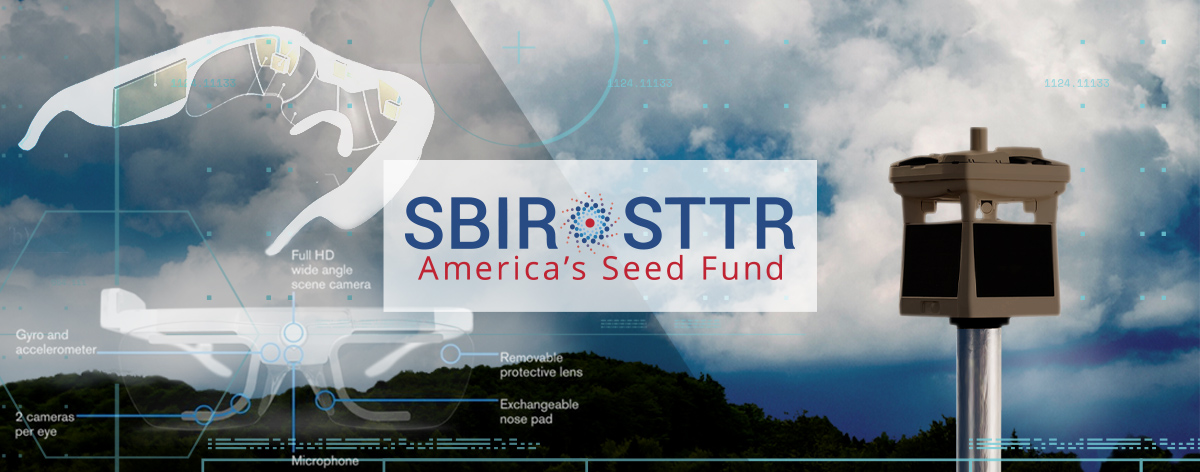
- Micro Weather Stations: To improve situational awareness and keep personnel out of the field, Intellisense Systems has combined more than 20 environmental parameters into a portable, self-contained compact box that can be started up in less than 60 seconds. The innovative device has been deployed in the U.S. and internationally.
- IoT Flood Sensors: Flooding is the biggest natural disaster in the United States, costing hundreds of lives and billions in property damage each year. To address the increasing risks of flooding, Intellisense Systems has developed a network of low-cost flood sensors that improve community preparedness by sending out flood alerts in almost real time.
- Rugged Avionics Displays: To keep the world’s largest aircraft in service, Intellisense Systems has developed form-fit-function replacements that are high-definition, sunlight readable, and open source for future software upgrades.
Intellisense has developed hundreds of technologies with seed funding from the SBIR program. It has also leveraged prior work to initiate Sequential Phase II programs as derivatives from prior Phase I or Phase II contracts. The SBIR advantages ensure the rapid development of technological solutions that address issues of national importance, as well as benefit the international community.