
To maintain its aerial combat advantage, the United States Air Force conducts exercises that require landing on unprepared surfaces. Thankfully, the Micro Weather Station is there to provide important weather data to pilots in the air and personnel on the ground.
On August 5, 2021, the Micro Weather Station (MWS®) from Intellisense Systems served in an extraordinary military exercise. For the first time ever, a military combat aircraft landed on a public highway in the United States. This first-of-its-kind operation was part of an exercise conducted by the U.S. Air Force’s 354th Fighter Squadron. The goal of the exercise was to train pilots to complete successful landings on improvised runways like a highway or rural road.
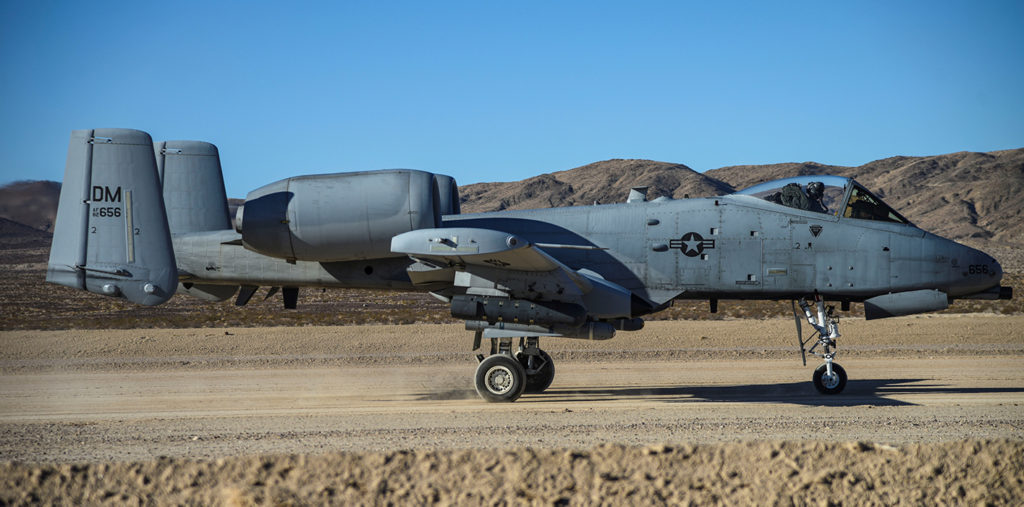
Just six months later, the 354th Fighter Squadron tackled the even greater challenge of landing aircraft on a dry lakebed. Once again, the MWS was there to deliver critical weather information to pilots and mission planners.
In an exercise christened “Green Flag-West” at Fort Irwin National Training Center in California, the MWS-M625 model of the Micro Weather Station provided essential weather data for landings on a makeshift runway in the Mojave Desert. The portable, wireless, solar-powered M625 reported key weather readings in a remote location where no other ground-level observations were available.
During the exercise, Air Force personnel found that — thanks to the MWS — the temperature differed slightly at the makeshift landing site compared to the data from an automated weather station located a few kilometers away at Fort Irwin. These proximate and accurate temperature readings at the landing site gave the A-10 Thunderbolt pilots crucial information for calculating fuel levels for takeoffs and landings.
“The portability of the MWS-M625 and the capability we now have to remain agile is the greatest advantage provided,” said Tech. Sgt. Ahmad Long, the noncommissioned officer in charge of the 355th Operations Support Squadron Weather Flight mission weather integration function. “The primary purpose of the MWS-M625 is to support contingency locations, where it is paramount for our forecasters to be light and lethal.”
In addition to accurate weather observations close to the landing site, the MWS-M625 was moved swiftly and easily to different locations around the dry lakebed to take weather observations as mission requirements changed. Thanks to its integrated solar power system, the station was operational throughout the exercise without needing to be plugged in or recharged. These capabilities set the MWS apart from the Air Force’s legacy weather stations, which weighed nearly 300 pounds and required a dedicated power source.
“The MWS-M625 provides many new opportunities,” said U.S. Air Force Staff Sgt. Danah Mallory, 355th OSS Weather Flight weather craftsman and Green Flag-West weather forecaster. “Its size provides the ability to travel light and set up quickly. The ease-of-use enables us to quickly train Airmen in other Air Force Specialty Codes to monitor conditions and supplement weather support in case of an emergency.”