The Revolutionary IWOS Compared to Traditional Weather Stations
A new guide from Intellisense Systems examines how the Integrated Weather Observation System (IWOS) addresses the needs of the United States Air Force and modernizes weather monitoring systems in terms of size, portability, and customization.
To achieve its mission of air combat superiority, the United States Air Force relies on an array of environmental-sensing instruments to capture accurate weather data in the world’s most remote areas. This data ensures the safety and success of military operations in isolated, denied, or otherwise inaccessible regions where mission planners need to make critical decisions. These tools need to not only transmit essential environmental parameters like visibility, wind speed/direction, and cloud layers, but also report this key data autonomously with a solar-powered system and satellite communications.
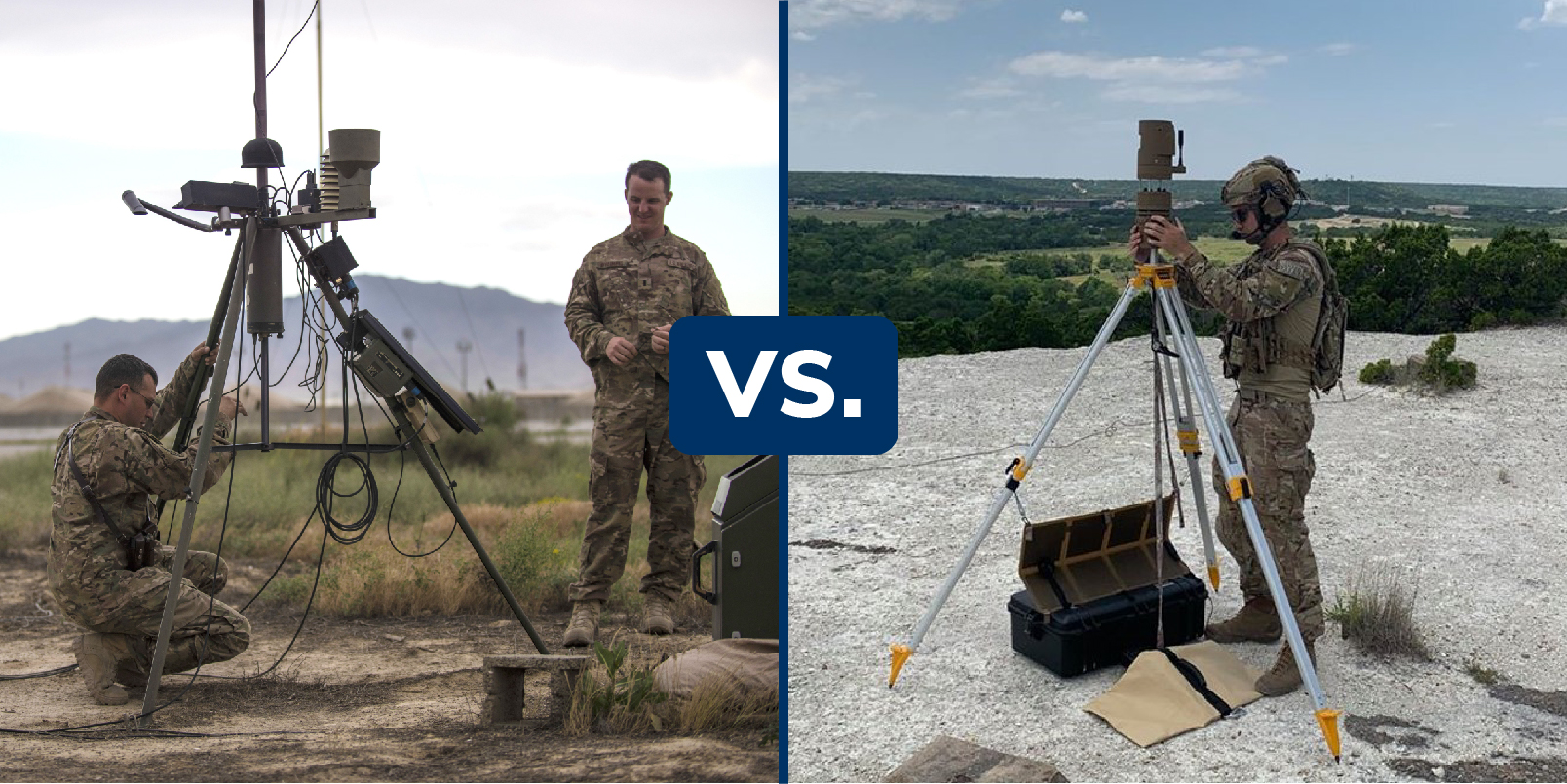
Unfortunately, those capabilities are not typically present in traditional weather stations. For the last 30 years, the Air Force has deployed numerous weather-sensing systems to fulfill this need. Their primary solution, which was designed for autonomous weather observations at remote airfields, consisted of up to 80 separate pieces and weighed approximately 100 lb. Another solution attempted to consolidate this functionality into only four pieces of equipment, but the program was terminated in 2010 without a permanent replacement.
That same year, the Department of Defense (DoD) issued a request for proposal to develop a portable weather station that could supply vital weather data in a hand-held solution for rapid response and greater ease-of-use. Through the DoD’s Small Business Innovation Research (SBIR) initiative, Intellisense Systems, Inc. was awarded multi-phase contracts to develop the Micro Weather Station (MWS®), which is now deployed for both military and commercial operations all over the world.
But the engineers at Intellisense Systems were not content with just improved portability. They sought to design a mobile weather station that was competitive with larger, permanent environmental-monitoring systems in terms of range, resolution, and accuracy. With that goal in mind, they developed the Integrated Weather Observation System (IWOS) to meet the requirements put forth by the Air Force and consolidate many weather-observation systems into one unit. This revolutionary weather-sensing product integrates over a dozen key sensors with integrated data processing, logging, and communications, enabling it to report over a dozen parameters from a single package that fits into a single case and weighs just 25 lb.
So how did they do it? The latest guide from Intellisense Systems looks at how the IWOS revolutionizes previous weather monitoring systems and fulfills the needs for both military and commercial applications. This seven-page document details IWOS’s many enhancements by highlighting six key improvements:
System Size
Cloud Layer Measurements
Installation/Operation
Visual Imagery
Communications
Cost
Download the full guide by completing the form on the right.
 To achieve its mission of air combat superiority, the United States Air Force relies on an array of environmental-sensing instruments to capture accurate weather data in the world’s most remote areas. This data ensures the safety and success of military operations in isolated, denied, or otherwise inaccessible regions where mission planners need to make critical decisions. These tools need to not only transmit essential environmental parameters like visibility, wind speed/direction, and cloud layers, but also report this key data autonomously with a solar-powered system and satellite communications.
Unfortunately, those capabilities are not typically present in traditional weather stations. For the last 30 years, the Air Force has deployed numerous weather-sensing systems to fulfill this need. Their primary solution, which was designed for autonomous weather observations at remote airfields, consisted of up to 80 separate pieces and weighed approximately 100 lb. Another solution attempted to consolidate this functionality into only four pieces of equipment, but the program was terminated in 2010 without a permanent replacement.
That same year, the Department of Defense (DoD) issued a request for proposal to develop a portable weather station that could supply vital weather data in a hand-held solution for rapid response and greater ease-of-use. Through the DoD’s Small Business Innovation Research (SBIR) initiative, Intellisense Systems, Inc. was awarded multi-phase contracts to develop the Micro Weather Station (MWS®), which is now deployed for both military and commercial operations all over the world.
But the engineers at Intellisense Systems were not content with just improved portability. They sought to design a mobile weather station that was competitive with larger, permanent environmental-monitoring systems in terms of range, resolution, and accuracy. With that goal in mind, they developed the Integrated Weather Observation System (IWOS) to meet the requirements put forth by the Air Force and consolidate many weather-observation systems into one unit. This revolutionary weather-sensing product integrates over a dozen key sensors with integrated data processing, logging, and communications, enabling it to report over a dozen parameters from a single package that fits into a single case and weighs just 25 lb.
So how did they do it? The latest guide from Intellisense Systems looks at how the IWOS revolutionizes previous weather monitoring systems and fulfills the needs for both military and commercial applications. This seven-page document details IWOS’s many enhancements by highlighting six key improvements:
To achieve its mission of air combat superiority, the United States Air Force relies on an array of environmental-sensing instruments to capture accurate weather data in the world’s most remote areas. This data ensures the safety and success of military operations in isolated, denied, or otherwise inaccessible regions where mission planners need to make critical decisions. These tools need to not only transmit essential environmental parameters like visibility, wind speed/direction, and cloud layers, but also report this key data autonomously with a solar-powered system and satellite communications.
Unfortunately, those capabilities are not typically present in traditional weather stations. For the last 30 years, the Air Force has deployed numerous weather-sensing systems to fulfill this need. Their primary solution, which was designed for autonomous weather observations at remote airfields, consisted of up to 80 separate pieces and weighed approximately 100 lb. Another solution attempted to consolidate this functionality into only four pieces of equipment, but the program was terminated in 2010 without a permanent replacement.
That same year, the Department of Defense (DoD) issued a request for proposal to develop a portable weather station that could supply vital weather data in a hand-held solution for rapid response and greater ease-of-use. Through the DoD’s Small Business Innovation Research (SBIR) initiative, Intellisense Systems, Inc. was awarded multi-phase contracts to develop the Micro Weather Station (MWS®), which is now deployed for both military and commercial operations all over the world.
But the engineers at Intellisense Systems were not content with just improved portability. They sought to design a mobile weather station that was competitive with larger, permanent environmental-monitoring systems in terms of range, resolution, and accuracy. With that goal in mind, they developed the Integrated Weather Observation System (IWOS) to meet the requirements put forth by the Air Force and consolidate many weather-observation systems into one unit. This revolutionary weather-sensing product integrates over a dozen key sensors with integrated data processing, logging, and communications, enabling it to report over a dozen parameters from a single package that fits into a single case and weighs just 25 lb.
So how did they do it? The latest guide from Intellisense Systems looks at how the IWOS revolutionizes previous weather monitoring systems and fulfills the needs for both military and commercial applications. This seven-page document details IWOS’s many enhancements by highlighting six key improvements:
