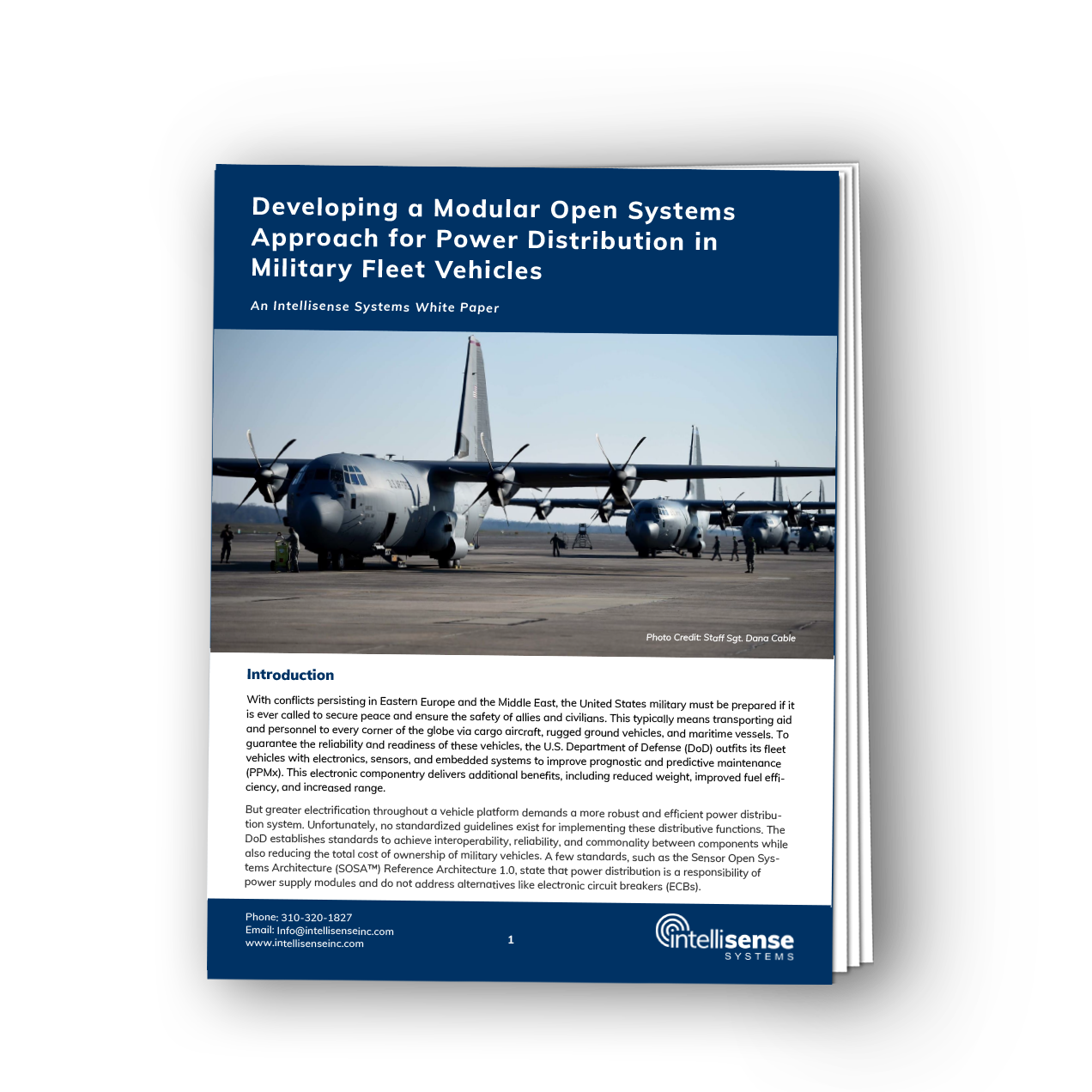
Intellisense Systems is Developing a Modular Open Systems Approach for Power Distribution in Military Vehicles
To ensure that the United States’ military fleet vehicles are ready and available to respond to crises around the world, Intellisense Systems is chairing a new study group to devise a modular open systems approach for power distribution across all kinds of vehicle platforms.
With wars now raging in Eastern Europe and the Middle East, the United States military must be prepared if they are ever called to secure peace and ensure the safety of allies and civilians. This means transporting aid and personnel to every corner of the globe via the world’s most advanced cargo aircraft, rugged ground vehicles, and maritime vessels.
To guarantee the reliability and readiness of these vehicles, the U.S. Department of Defense (DoD) outfits its fleet vehicles with electronics, sensors, and embedded systems to improve prognostic and predictive maintenance (PPMx). By accessing data through vehicles’ electronic components, military personnel and engineers can detect faults in vehicles to ensure mission readiness and success once they deployed. In addition to PPMx, more electronics in military vehicles deliver added benefits such as reduced weight, improved fuel efficiency, and increased range.
But greater electrification inside vehicle platforms demands a more robust and efficient power distribution system. Unfortunately, no standardized guidelines exist for implementing these distributive functions. The DoD establishes standards to achieve interoperability, reliability, and commonality between components while also reducing the total cost of ownership of military vehicles. A few standards, such as the Sensor Open Systems Architecture (SOSA™) Reference Architecture 1.0, state that power distribution is a responsibility of power supply modules and do not address alternatives like electronic circuit breakers (ECBs).
ECBs have been successfully have been successfully employed in hundreds of commercial and military aircraft over the last thirty years. They enable pilots and crewmembers to monitor breaker status on their flight displays and to remotely control the electronic power distribution throughout the aircraft. ECBs also greatly reduce weight and complexity by eliminating duplicative wiring and multiple power supply modules.
Because of the proven success of ECBs in military aircraft, the DoD is exploring their applicability in ground vehicles and watercraft. The expanded use of ECBs can significantly improve operational efficiency and help maintaining the U.S. military’s domain advantage across all arenas. Additionally, the use of common componentry between various platforms can also ensure the availability of parts and mitigate diminishing manufacturing sources and material shortages.
The newest white paper from Intellisense Systems details a modular open systems approach standard in the production of power distribution components that can be used across all military fleet vehicles, from aircraft to ground vehicles to maritime vessels. This standard can support dual-use applications as well. The use of common components across air, sea, and ground vehicles can support PPMx, achieve significant fuel savings, extend mission duration, and increase the availability and readiness of the entire U.S. military fleet. This, in turn, will ensure that the U.S. Armed Forces are prepared for whatever conflicts arise throughout the 21st century.
Download the full white paper by completing the form on the right.
 With wars now raging in Eastern Europe and the Middle East, the United States military must be prepared if they are ever called to secure peace and ensure the safety of allies and civilians. This means transporting aid and personnel to every corner of the globe via the world’s most advanced cargo aircraft, rugged ground vehicles, and maritime vessels.
To guarantee the reliability and readiness of these vehicles, the U.S. Department of Defense (DoD) outfits its fleet vehicles with electronics, sensors, and embedded systems to improve prognostic and predictive maintenance (PPMx). By accessing data through vehicles’ electronic components, military personnel and engineers can detect faults in vehicles to ensure mission readiness and success once they deployed. In addition to PPMx, more electronics in military vehicles deliver added benefits such as reduced weight, improved fuel efficiency, and increased range.
But greater electrification inside vehicle platforms demands a more robust and efficient power distribution system. Unfortunately, no standardized guidelines exist for implementing these distributive functions. The DoD establishes standards to achieve interoperability, reliability, and commonality between components while also reducing the total cost of ownership of military vehicles. A few standards, such as the Sensor Open Systems Architecture (SOSA™) Reference Architecture 1.0, state that power distribution is a responsibility of power supply modules and do not address alternatives like electronic circuit breakers (ECBs).
ECBs have been successfully have been successfully employed in hundreds of commercial and military aircraft over the last thirty years. They enable pilots and crewmembers to monitor breaker status on their flight displays and to remotely control the electronic power distribution throughout the aircraft. ECBs also greatly reduce weight and complexity by eliminating duplicative wiring and multiple power supply modules.
Because of the proven success of ECBs in military aircraft, the DoD is exploring their applicability in ground vehicles and watercraft. The expanded use of ECBs can significantly improve operational efficiency and help maintaining the U.S. military’s domain advantage across all arenas. Additionally, the use of common componentry between various platforms can also ensure the availability of parts and mitigate diminishing manufacturing sources and material shortages.
The newest white paper from Intellisense Systems details a modular open systems approach standard in the production of power distribution components that can be used across all military fleet vehicles, from aircraft to ground vehicles to maritime vessels. This standard can support dual-use applications as well. The use of common components across air, sea, and ground vehicles can support PPMx, achieve significant fuel savings, extend mission duration, and increase the availability and readiness of the entire U.S. military fleet. This, in turn, will ensure that the U.S. Armed Forces are prepared for whatever conflicts arise throughout the 21st century.
With wars now raging in Eastern Europe and the Middle East, the United States military must be prepared if they are ever called to secure peace and ensure the safety of allies and civilians. This means transporting aid and personnel to every corner of the globe via the world’s most advanced cargo aircraft, rugged ground vehicles, and maritime vessels.
To guarantee the reliability and readiness of these vehicles, the U.S. Department of Defense (DoD) outfits its fleet vehicles with electronics, sensors, and embedded systems to improve prognostic and predictive maintenance (PPMx). By accessing data through vehicles’ electronic components, military personnel and engineers can detect faults in vehicles to ensure mission readiness and success once they deployed. In addition to PPMx, more electronics in military vehicles deliver added benefits such as reduced weight, improved fuel efficiency, and increased range.
But greater electrification inside vehicle platforms demands a more robust and efficient power distribution system. Unfortunately, no standardized guidelines exist for implementing these distributive functions. The DoD establishes standards to achieve interoperability, reliability, and commonality between components while also reducing the total cost of ownership of military vehicles. A few standards, such as the Sensor Open Systems Architecture (SOSA™) Reference Architecture 1.0, state that power distribution is a responsibility of power supply modules and do not address alternatives like electronic circuit breakers (ECBs).
ECBs have been successfully have been successfully employed in hundreds of commercial and military aircraft over the last thirty years. They enable pilots and crewmembers to monitor breaker status on their flight displays and to remotely control the electronic power distribution throughout the aircraft. ECBs also greatly reduce weight and complexity by eliminating duplicative wiring and multiple power supply modules.
Because of the proven success of ECBs in military aircraft, the DoD is exploring their applicability in ground vehicles and watercraft. The expanded use of ECBs can significantly improve operational efficiency and help maintaining the U.S. military’s domain advantage across all arenas. Additionally, the use of common componentry between various platforms can also ensure the availability of parts and mitigate diminishing manufacturing sources and material shortages.
The newest white paper from Intellisense Systems details a modular open systems approach standard in the production of power distribution components that can be used across all military fleet vehicles, from aircraft to ground vehicles to maritime vessels. This standard can support dual-use applications as well. The use of common components across air, sea, and ground vehicles can support PPMx, achieve significant fuel savings, extend mission duration, and increase the availability and readiness of the entire U.S. military fleet. This, in turn, will ensure that the U.S. Armed Forces are prepared for whatever conflicts arise throughout the 21st century.